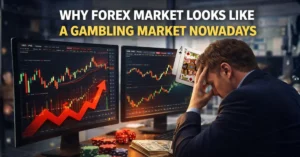
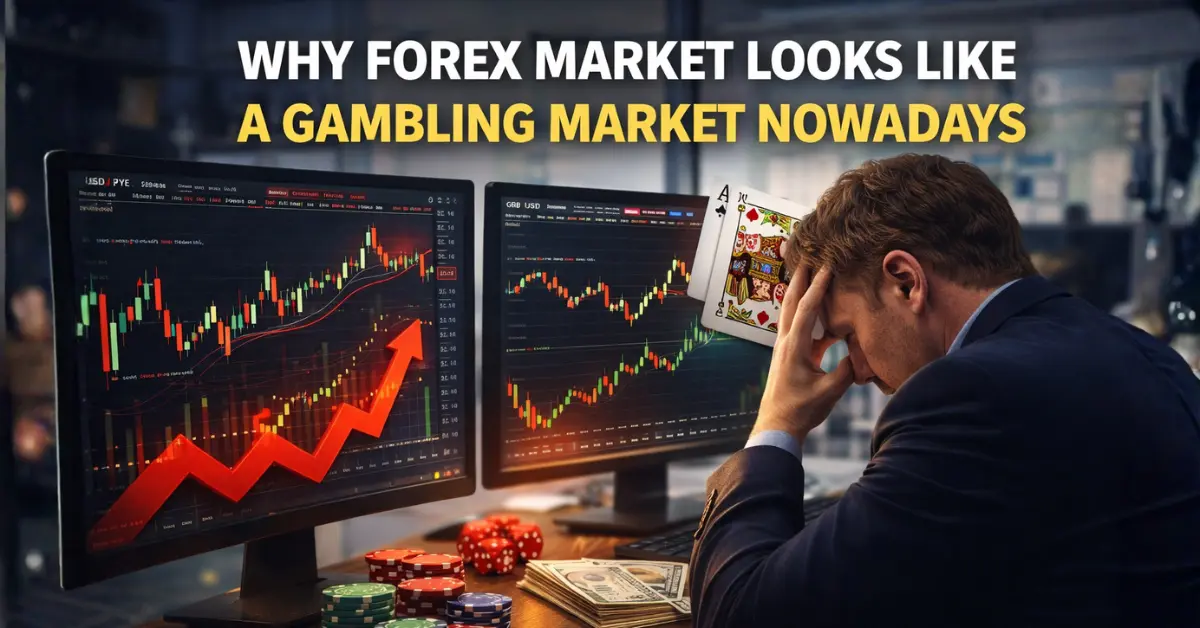
The Forex market is the world’s largest and most liquid financial market, with over $6 trillion traded every day. Traders buy and sell currencies based on economic fundamentals, geopolitical events, and market sentiment. Yet, over the past few years, many investors and analysts have started to compare the Forex market to gambling. But why? Is there a growing trend of speculative behavior in Forex that resembles gambling? Let’s explore this notion and break down why some people believe the market is becoming more like a game of chance.
The Increasing Role of Speculation
One of the primary reasons why many view the Forex market as resembling a gambling environment is the growing role of speculative trading.
Traditionally, Forex was used for hedging purposes, where businesses would exchange currencies to mitigate the risk of fluctuating exchange rates. However, over the years, speculative trading has become the dominant force in the Forex market. Traders are now more focused on profiting from short-term price fluctuations, often ignoring underlying economic fundamentals.
Many traders, especially those in the retail Forex market, are using leverage to amplify their positions. Leverage allows traders to control larger positions with smaller amounts of capital, but it also increases the risk of significant losses. This creates a situation where traders are more likely to gamble on market movements than to make informed, calculated trades.
Emphasis on Short-Term, High-Risk Trades
In today’s Forex market, many traders are looking for quick profits. With the advent of online trading platforms, retail traders can open positions and make transactions within seconds. These quick, high-risk trades have made the Forex market resemble more of a casino rather than a traditional financial market.
The constant fluctuations in currency pairs mean that traders are often making short-term bets rather than strategic, long-term investments. While some traders may argue that this adds excitement and dynamism to the market, it also introduces high volatility and encourages reckless behavior, which is reminiscent of gambling.
Influence of Online Brokers and Platforms
The rise of online brokers and trading platforms that cater to retail traders has also played a role in transforming the Forex market. These platforms often use flashy advertisements and incentives to attract individuals, promising them that they can make quick profits with just a few clicks.
In many cases, brokers may even offer bonuses to traders who open new accounts or meet trading volume requirements. This creates an environment where traders are encouraged to take more risks, chase profits, and get involved in high-frequency trading. It is not unlike the way casinos offer loyalty programs or rewards to gamblers.
Some platforms even offer automated trading robots (also called expert advisors), which allow traders to set up trades based on algorithms. While this technology can make trading more accessible to novice traders, it also means that many traders are relying on systems that don’t take into account market fundamentals or long-term strategies.
Market Volatility and Short-Term Price Movements
Another characteristic that makes the Forex market appear more like gambling is the increased volatility and short-term price movements. While volatility has always been a feature of the Forex market, recent events, such as the COVID-19 pandemic, Brexit, and the U.S.–China trade war, have introduced extreme levels of market uncertainty. These events have caused currencies to move erratically, and traders are often reacting impulsively, trying to catch the next big market move.
Currency pairs, like EUR/USD and GBP/USD, have experienced wild price swings within hours or even minutes. The reliance on technical analysis and news-based trading means that many traders are essentially betting on short-term price movements rather than making informed decisions based on economic data. This behavior mirrors gambling, where individuals are often placing bets based on gut feelings or speculative tips rather than careful, reasoned judgment.
The Appeal of Quick Money
Finally, one of the major similarities between Forex trading and gambling is the desire for fast profits. Both markets attract individuals who are hoping to get rich quickly. With leverage in the Forex market, traders can magnify their profits (or losses) by a large margin. This creates a cycle where people believe they can make fast and easy money, leading them to make rash decisions.
While some traders do succeed in making substantial profits, many others end up losing their entire investment. This is not unlike a gambling mentality, where people are drawn to the excitement of the market and the possibility of instant gains, even though the odds may not be in their favor.
Conclusion: Is Forex Really Like Gambling?
It’s clear that the Forex market has evolved over time. The increasing role of speculation, short-term trades, leverage, and the influence of online brokers have made it look more like a gambling market. However, it’s important to remember that Forex is still a financial market that is fundamentally driven by global economic conditions, trade policies, and political events.
While it’s true that certain aspects of the market resemble gambling, such as the potential for rapid profits and risks, it’s crucial to distinguish between the two. Forex trading can be profitable if approached with proper knowledge, risk management, and long-term strategies.
Ultimately, the key difference lies in discipline. Traders who make educated, well-thought-out decisions based on analysis and careful planning are more likely to be successful in the Forex market. Those who approach it with a gambling mindset — relying on luck or impulse — are more likely to lose money.
As always, education and risk management are the most important tools for anyone entering the Forex market. So, while the Forex market may seem like a gamble at times, it is not inherently one. It’s up to the trader to make informed decisions and approach it with a clear strategy.